
Complex contours, gear profiles, holes and forming operations in a single press stroke: these are the geometries and thicknesses that fineblanking can accommodate, and how to validate them.
Fineblanking technology makes it possible to produce flat, precise metal components with clean edges in a single press stroke. For product engineering and purchasing teams, the key question is usually what shapes and material thicknesses the process can accommodate. The answer directly affects part cost, the number of secondary operations required, and production repeatability. The following sections review the most common geometries, design considerations, and thickness ranges to take into account.
What Makes Fineblanking Parts Different?
Fineblanking combines conventional stamping with cold extrusion. It operates on triple-action presses: a blank holder clamps the sheet metal, a counter punch supports it from below, and the punch cuts with minimal clearance.
This clamping action prevents the material from tearing during cutting. The result is a smooth, straight edge through almost the entire material thickness, without the fracture zone typically associated with conventional stamping.
- Functional edges: The cut edge can serve as a support or guiding surface without secondary finishing operations.
- Flatness: Parts leave the press with a level of flatness that is difficult to achieve with other sheet metal processes.
- Repeatability: The tooling defines the geometry, ensuring that the first and last parts of a production run are virtually identical.
Geometries Suitable for Fineblanking
Contours, Gears and Holes
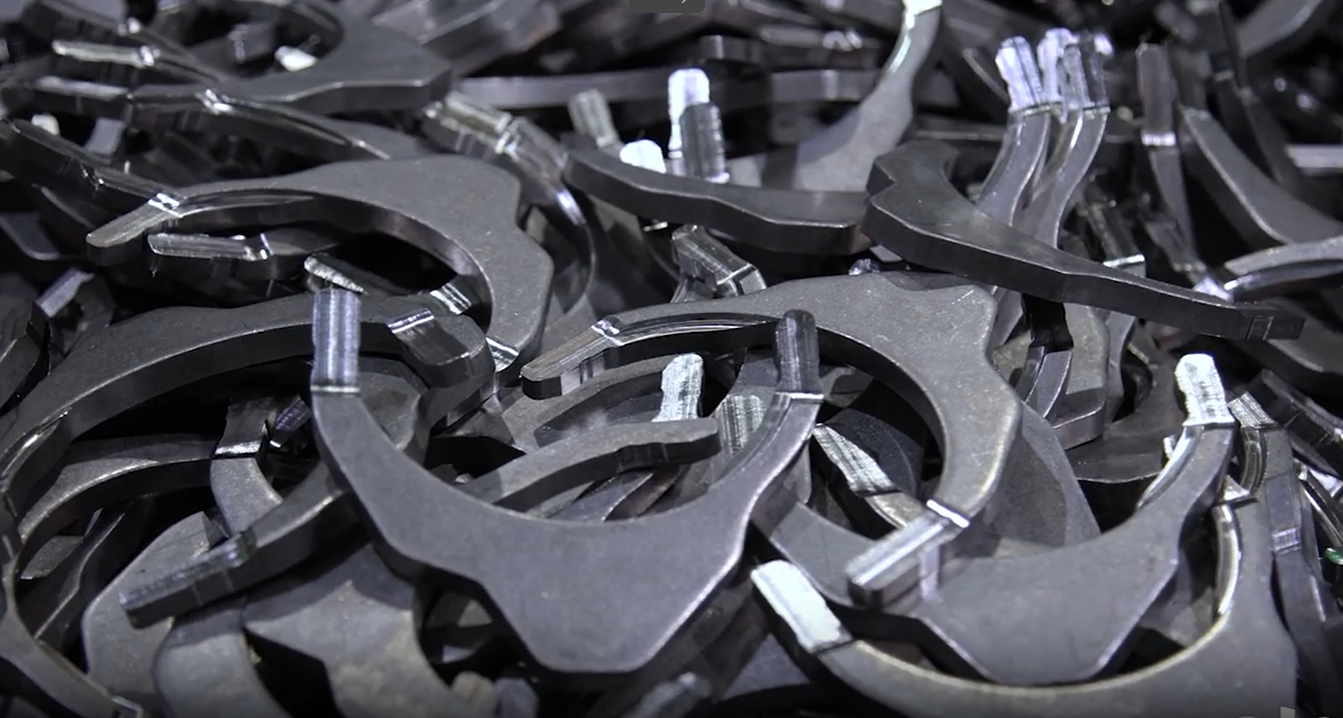
Fineblanking is particularly effective for complex external contours, small radii, and sharp changes in direction. It is also commonly used for external and internal gear profiles, cams, toothed segments, and ratchet profiles. Holes, slots, and internal openings are cut in the same stroke as the outer contour. As a result, the relative position of the holes is defined by the tooling itself and does not depend on subsequent fixturing operations.
Forming Operations in the Same Tool
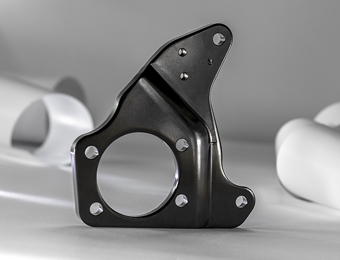
In addition to cutting, the tooling can incorporate forming operations. The most common include countersinking, semi-punching, coining, shallow drawing, and simple bends.
A progressive die can combine these operations across multiple stations. This means that a component that previously required separate drilling, countersinking, and bending operations can leave the press fully finished.
Design Considerations to Review
Not all geometries are equally suitable for the fineblanking process. Several design features influence tool life and edge quality:
- Corner radii: Sharp corners concentrate stresses on the tooling, while generous radii extend tool life.
- Webs and bridges: Very short distances between holes, or between a hole and the outer contour, can weaken both the punch and the part.
- Small holes relative to material thickness: The thicker the sheet metal, the more challenging it becomes to produce small-diameter holes
- Edge rollover: A slight rounding appears at the point where cutting begins and should be considered in functional dimensions.
Reviewing these aspects with the manufacturer during the design stage is usually far more effective than making corrections once the tooling has already been built.
Thicknesses and Materials: The Process Range
The maximum achievable thickness depends primarily on press force and part size. As thickness and cutting perimeter increase, higher tonnage is required.
For thin sheet metal, the main challenge is maintaining flatness and avoiding deformation in narrow sections. For thicker materials, the focus shifts to tool strength and maintaining edge quality throughout the entire thickness.
Common materials include carbon steel, stainless steel, aluminum, and copper. The final selection depends on the component's function, subsequent processing requirements, and target cost.
The surface finish and thickness consistency of the non-cut surfaces are determined by the quality of the raw material. When standard material quality is not sufficient, Elay offers double-disc grinding processes that improve surface finish, flatness, and thickness tolerances.
How Elay Manufactures Complex Components
Elay operates more than 17 triple-action fineblanking presses ranging from 320 to 1,200 tonnes across its three production plants. This equipment enables the company to guarantee fineblanking thicknesses of up to 16 mm.
- Feature integration: Multiple shapes and details are combined into a single cutting operation, eliminating secondary processes.
- In-house tooling: Through collaborative product design with customers, Elay designs and manufactures its own tooling for both short and long production runs.
- Technology substitution: The company evaluates the conversion of die-cast aluminum, sintered, and laser-cut components to fineblanking technology.
- Complete assemblies: Complementary operations include machining, welding, riveting, and assembly.
These capabilities are applied to automotive components used in seating systems, axles, latching mechanisms, transmission systems, and connectors, as well as in many other industries.
Validate the Geometry Before Industrialisation
The feasibility of a fineblanking part is determined at the drawing stage: contour, radii, webs, thickness, and material selection are all critical factors. Optimising these parameters early reduces tooling costs and eliminates unnecessary secondary operations. Ideally, the design should be reviewed with the manufacturer before finalising dimensions.
For the evaluation of a specific component, Elay's technical team is available through its contact page.